Saturday, 20 April 2019

America’s Best Employers 2019


America’s Best Employers 2019

Trader Joe's
Trader Joe's2015 TORONTO STAR
If ever there were an ideal time to be a job seeker, this past year was surely it. Record-setting job gains and consistently low unemployment rates gave rise to a labor landscape not seen by Americans in decades, one where companies found themselves competing hard to attract and retain their workforces. In doing so, some emerged from the talent war as employers of choice.
Forbes teamed up with market research company Statista m to pinpoint the companies liked best by employees in our annual ranking of America’s best employers. The ranking is divided into two lists: one for the top large companies with more than 5,000 U.S. employees, and another for the top midsize companieswith 1,000 to 5,000. This article focuses on the former.

Over the past few years, a Monrovia, California-based grocery chain has been steadily scaling the ranks, rising 18 spots in two years to hit No. 2 in 2018. This year there was just one place left to climb, and the retailer proved it was up to the challenge, securing the No. 1 spot ahead of competitors Costco Wholesale (No. 4) and Wegmans Food Markets (No. 19). Since founding as convenience store Pronto Markets in 1958, America’s best employer has come a long way, even changing its name over the years. You may have heard of it: Trader Joe’s.
Aside from its name and number of locations—more than 400 and counting across 41 states and the District of Columbia—not much has changed at Trader Joe’s since founder (and original trader) Joe Coulombe opened shop. Its consistent attention to the basics may be the secret to its success. “We’ve been around for over 50 years, and we’ve never had layoffs. We stay true to what we know works for Trader Joe’s and our crew members,” says Jon Basalone, president of stores at Trader Joe’s. “You combine that with the pay, benefits and supportive, fun environment, and people tend to want to stick around.”

Trader Joe's

While many retailers cling to the notion that the minimum wage prescribed by the law must be the minimum wage paid to front-line employees, Trader Joe’s takes a different approach, establishing unique base wages in each of the markets in which it sets up shop. Each minimum wage is based on what it will take to attract the best in any given area, and over time, even part-time crew members can earn up to $24.75 an hour—nearly twice as much as the nation’s highest minimum wage, enjoyed by workers in Washington, D.C. Just as competitive pay isn’t considered a perk, neither is access to benefits, with health insurance, paid time off and a company-funded retirement plan offered to those who work part-time on the store floor and full-time in the C-suite alike. And because Trader Joe’s is open 18 hours a day, seven days a week, there’s a lot of flexibility. “No matter what people have going on in their lives, whether they’re students, whether this is their second job, whether they’re pursuing other interests and just need a job, we can help them,” Basalone says. “We hire individuals, we embrace their individuality and we get the work done through teamwork.”
Trader Joe’s culture of comradeship is strong—so strong it can be sensed by anyone who walks into a store. The crew’s distinctive uniform, donned by all since the 1960s, helps set the tone. “We all wear Hawaiian shirts and nametags—and the nametags all say ‘crew member’—especially here in the office,” Basalone says. “If a store calls and says, ‘We need someone to help us come bag,’ we’re ready.” So, on any given day, a student working part-time might find himself ringing up a customer’s Mandarin Orange Chicken alongside a long-time executive. And a few hours later, that same student might be called from behind the register and into the backroom to try whatever variation on Speculoos Cookie Butter the store has dared to dream up next during a tasting panel: a twice-weekly practice at Trader Joe’s, during which crew members sample and weigh in on products before they hit the shelves. Of the many tasks on a crew member’s to-do list, tasting panels are surely a favorite, so much so that 28 years later, Basalone can still recall the spread at his first: 10 dips, a frozen food and a baked good. “My first day at Trader Joe’s, I was being shown how to cut open a box and stock some frozen food, and someone came up and said, ‘Let’s go in the back—we’re having a tasting,’” he says. “The whole time, I was thinking, ‘Am I supposed to be doing this? I feel like I should be at work,’ and the person training me said, ‘No, this is a part of it. We’ve got to learn about what we sell.’”

Trader Joe's
Trader Joe's2015 TORONTO STAR
Trader Joe’s efforts to support its workforce surely haven’t hurt its ability to attract and retain talent, but the key to its status as a sought-after employer can’t be found in any compensation plan or inverted organizational chart, Basalone says: “It almost doesn’t feel like work—it feels more like we’re hosting a party and the customers are the honored guests. You get to meet and work with some amazing people, whether your fellow crew members or customers, and the interaction and energy that comes from that just makes it a really great place to work.”
NDTV Web Developer

Why Fortnite's Iceberg Points To A Giant Upcoming Boss Fight


Why Fortnite's Iceberg Points To A Giant Upcoming Boss Fight

Fortnite
Fortnite
 CREDIT: EPIC GAMES
Something strange happened in Fortnite: Battle Royale yesterday. Shortly after the game went live with update 7.20 yesterday, people noticed an iceberg tuck way down in the southwestern corner of the map. It had a health bar, but it was bigger than anything else in the game by a considerable margin: 5,000,000,000, to be exact. It also seemed to be going down, albeit not very quickly. As the pace accelerated, however, it became clear that people were actually damaging the thing in real time, and that the health bar on the iceberg represented the damage being done to the iceberg by all players, in all games: a far cry from the usually siloed-off instances that each match takes place in. The pace accelerated as more players learned about the iceberg, and eventually, the thing hit zero. In its place? Another weird, unbreakable bunker: anticlimactic
On its own, this seems a little obtuse, even for Fortnite. It wouldn’t make much sense as an in-game event: it came and ended without warning or anything particularly interesting, and most people playing the game probably never had any idea that it was happening at all. If it was an event, it was a strange, uneventful sort of event. But I don’t think the iceberg itself was the main point: something small like this is exactly what you would do if you were testing out a brand-new mechanic in the game and wanted to make sure it worked before its actual purpose.
So what would a mechanic like this be useful for? It seems pretty simple, actually: a world boss. That would mean a single, giant enemy with a single shared health bar between all worlds, basically a version of the iceberg that fought back, and one that likely had a whole lot more health. Communication between game instances isn’t really something Fortnite has ever done before, so the team would likely want to make sure it worked before any sort of event.
It dovetails with some of what we’ve been hearing about the upcoming Ice Storm event: leaked challenges point to something called an “Ice Legion”, which I first took to be an army of ice husks akin to the cube monsters from Fortnitemares. But what if it’s not? What if it’s either a single enemy or at the very least an army with some sort of mechanic that would require everyone to cooperate and take it down in real time? 
That’s my guess, at least: it would seem to make sense with this recent Iceberg thing, and it would also be something new and weird for Epic Games. Epic Games, for its part, has proven a commitment to the new and weird, and this one would both be something out of left field for this game and also contain potentially useful network tools for other Unreal projects. We’ll see what happens, and likely soon
NDTV Web Developer

Thursday, 18 April 2019

Wi-Fi Camera Buying Guide


Wi-Fi Camera Buying Guide


If you can’t be physically present to keep an eye on your home, business or vacation property, the next best thing is a state-of-the-art Wi-Fi camera that can stream real-time video to the device of your choice.
Unlike typical security cameras, network cameras, Cloud Cameras, or Wi-Fi Cameras don’t require a closed circuit TV system and special cabling to work. Instead, they connect to your home’s existing network via Ethernet or Wi-Fi, just like a laptop or tablet. Once connected, they stream live video you can access from any connected computer. The most flexible systems even let you view feeds through a web browser, smartphone or tablet; great for on-the-go viewing.
Wi-Fi cameras are the perfect solution for homeowners, business owners, pet owners, parents and anyone with something to watch. To help you sort through the choices, this guide offers some quick recommendations and plenty of info about key features to look for in your next camera.

Wi-Fi cameras for every need

The average home user needs reliable monitoring that doesn’t cost an arm and a leg, whereas a business owner might be interested in greater functionality and integration with existing security systems. Network cameras fall into two classes corresponding to these types of users.
Entry Level Cameras
These cameras are small, very affordable and perfect for the home user. Designed to be easy to set up and easy to use, they connect to a wireless home network at the push of a button. Key features include:
  • Wireless capability and compact size for flexibility of placement
  • Low cost so you can purchase enough cameras to cover multiple areas
  • Ability to check camera feeds from any web browser, iPhone®, Android®, Windows device or tablet
Professional Level Cameras
These cameras are more expensive than entry-level cameras. However, the added investment pays off in upgraded features that make it possible to integrate your cameras with dedicated alarm and sensor systems. Key features include:
  • Designed for permanent installation, with durable, rugged housing
  • Wired or wireless connectivity
  • Outputs for alarm and access control systems
This guide will focus on entry level network cameras, as they offer plenty of functionality for the average household. If you need more robust features, visit the network camera page on dlink.com to learn more.

Features to look for

Not all cameras work the same way or offer the same capabilities. In this section, we’ll look at the most important features and what they mean to you.
Web Access 
Some cameras require software to access a camera’s output and only computers that have this software installed can view the feed. Other cameras, like D-Link Wi-Fi Cameras, offer more flexibility and are viewable using a web browser so you can check your cameras locally or remotely from any connected computer.
Wi-Fi Connectivity 
Wireless cameras give you the flexibility to keep an eye on areas that would be too hard to reach with a wired model. Setup simply involves connecting it to your existing home network just like you would a laptop or tablet. 
Mobile Apps
For truly mobile viewing, you need a camera that allows you to see a live feed from your smartphone or tablet. D-Link’s mobile interface is a free app called mydlink™ Lite and is available for iPhone, Android and Windowsdevices. The app works with all mydlink-enabled cameras and is completely free to use. With mydlink Lite, you can view your home or office and keep an eye on your kids, pets and possessions from anywhere with a Wi-Fi, 3G or 4G connection.
Motion Sensing 
If you choose to record footage only when motion is detected, you’ll save space and know exactly what footage you need to view. If you plan to record footage, select a camera that makes it easy to set motion triggers as well as specify recording schedules so you can record exactly what you want directly to a local microSD card.
Enhanced Motion Detection 
For more reliable motion detection day and night, certain cameras feature passive infrared (PIR) sensors that use changes in heat to detect movement, rather than visual cues. This is great for monitoring at night when a standard camera would not be able to detect motion due to low light conditions.
  • Recommended Models: DCS-2630L, DCS-5222L
Night Vision iPhone day-night2
Some Wi-Fi cameras can illuminate a low-light or no-light area with infrared lighting so you can clearly see what is happening day or night. Infrared lighting is invisible to the human eye but allows the camera a clear view, even in total darkness.
Sound Detection
For those looking to keep an eye on their loved ones or their homes while on vacation, sound detection is the perfect addition to the standard motion detection feature. With automatic email alerts and the ability to configure sound detection for a specific area, cameras with this feature allow you to stay one step ahead.
MicroSD Card Slot for Local Recording
Sometimes you need the ability to record footage in addition to viewing a live stream. All D-Link Wi-Fi Cameras support recording to a storage device, but for seamless use, most feature a microSD card slot, so you can record directly to a microSD card and view footage from anywhere using the free mydlink app or by logging in to www.mydlink.com. Local recording provides all the ease of use of cloud recording but without the price and bandwidth issues. D-Link’s cameras with MicroSD slots use H.264 enhanced video compression, which allows you to record up to 5x more footage when compared to MJPEG.

D-Link’s most popular cameras

camera buying guide chart_4-17

Find your perfect match

Let’s consider your monitoring needs and identify network camera models that suit you.
The ClassicDCS-936L_front (1)
You might be new to the Wi-Fi Camera world and you want to try one before you go all in or you just want a quick, affordable home security solution. You need a camera with infrared LEDs that give you a clear view day or night and enhanced motion detection so you can be alerted if there’s any movement inside when there shouldn’t be. 
  • Recommended Camera: HD Wi-Fi Camera (DCS-936L)
The 180-Degree
You want to keep a watchful eye on those in your care and monitor their daily activities. With a 180-Degree lens you can capture an entire room with one Wi-Fi camera, making it perfect for your larger, open spaces. You need a discreet camera with sound and motion detection and the clarity of 1080p HD so you can check in on your loved ones for peace of mind, anytime.
  • Recommended Camera: Full HD 180-Degree Wi-Fi Camera (DCS-2530L)
The Pan & Tilt
No matter how many shoes they chew up or how many rolls of toilet paper they shred, you love your pets. You need a camera with pan/tilt functionality and night vision, so you can get a clear view of your cherished companion no matter where they wander.
  • Recommended Camera: HD Pan & Tilt Wi-Fi Camera (DCS-5030L)
The Outdoor
This durable, weather-proof camera lets you keep tabs on important outdoor areas like your home’s exterior, your back yard, or the outside of your store or office
NDTV Web Developer

Old-School Tech: A List of Outdated Technology


Old-School Tech: A List of Outdated Technology


Top 5 Old-School Tech: A List of Outdated Technology

With the progression of time also comes the progression of technology. Today’s newest and most advanced device will likely be replaced in a year with something even better. It’s at the point where thinking about how people lived even 10 years ago seems like torture; what did we ever do without Facebook and smartphones? Obviously people got along just fine with their compasses and quill pens (that might be a bit too far in the past) but advances in technology continue to make our lives easier. Let’s take a look at the technology that has used up its 5 minutes of fame.

1. Fax Machines

I can easily say that I won’t miss the evil that is the fax machine, for some reason we seem to have a mutual hate for each other. To be honest, faxing has been fairly unnecessary for a while but some fax_machine_hp_1010people still feel more comfortable with a ‘hard copy’ document rather than one on a screen. Now that we have the ability to sign, scan and email documents just as easily and more reliably through email, fax machines have moved towards the storage closets rather than front and center of the copy room as they once were.

2. Pay Phones

With everyone from the age of 2 and up owning cell phones now, having public telephones where one has to pay with those things called coins is pointless. Even if someone didn’t have a cellphone, finding a fellow human to borrow one from would be like finding a piece of hay in a hay stack (that’s how the saying goes right?). The only real disadvantage of losing pay phones and phone booths is I now have no idea where Clark Kent plans on changing…

3. Home Phones

Having a land-line in a house that already has two or more cellphones has become obviously redundant. With our need for instant gratification the idea of waiting to call or talk to someone until iStock_000005190341XSmallwe get home is something of the past. For those who still have a land-line it’s mostly used as the throw away number to give to people you don’t really want need to talk to or is used to avoid telemarketers. With cell phones the person who answers is most likely the person you are calling which eliminates the awkwardness of asking if someone’s home. Bonus: The bad guys in scary movies now have a bit more a struggle considering cutting the land-line would do nothing and we have those handy flashlight apps on our phones.

4. Cameras and Camcorders

Don’t lie it’s been a while since you’ve even seen the word ‘camcorder’ hasn’t it? Yet another fabulous invention now proved pointless with our smartphones. The only person who would need a point and shoot camera, a camcorder and a telephone would be a hoarder, or a hipster, but I’m sure the hipster would only use a 35 mm with black and white film. The cameras on our phones have become comparable to the resolution one would get with their digital camera and it has the convenience of being able to share your photos instantly on Facebook or Instagram. Also with all the new apps one can easily film and edit a full movie all from their own cellphone, removing the process of uploading images and videos from multiple different devices onto a computer to edit. For the professional photographers and videographers, having the separate camera is still a necessity but for the average person the smartphone is all we need to post photos of our pets.

5. CD’s and DVD’s

Disk bagCD’s and DVD’s were once the greatest invention since … well … cassettes and VHS tapes. Being able to compile all those songs, movies or photos onto one donut shaped disc was groundbreaking. Collecting all of your favorites in a nice binder rather than shoe boxes saved quite a lot of space. But now people now have access to every song that’s ever been sung just through their phone or laptop with apps like Pandora and Spotify. And with Netflix and media players like D-Link’s MovieNite Plus (DSM-312), you can stream or rent movies anytime, from anywhere. Some people may stick to the old ways by keeping their physical copies (I still have my complete collection of 90’s boy band CD’s in my glove box) but getting half way through a movie and realizing its scratched is something I could happily live without.
The way technology moves at the speed of 11AC (get it?) it’s no surprise that almost as soon as new technology arrives it’s immediately replaced with the 2.0 version. So whether you’re the tech obsessed person that gets the newest and coolest phone once it’s released or the one who refuses to give up the flip phone from 2002 it’s totally cool, just make sure you’ve got at least one friend who paid attention in boy scouts or else when the zombie apocalypse finally happens we’re all done for
NDTV Web Developer

Tuesday, 16 April 2019

Infosys stock falls 3% after CFO Ranganath’s exit


Infosys stock falls 3% after CFO Ranganath’s exit

The market capitalization of the IT major eroded by Rs10,079.73 Cr on the latest exit of CFO M D Ranganath.
Infosys stock falls 3% after CFO Ranganath’s exit
The exit of CFO M D Ranganath from IT major Infosys led to a 3% fall in the stock price of the company yesterday, eroding Rs 10,079.73 Cr from the company’s market capitalization.
Ranganath, fondly known as Ranga, who has been working with Infosys for close to two decades, resigned in a surprise move that again raised questions about stability at the country’s second largest IT services firm.
The stock opened on a weak note at Rs 1,388.70 on BSE, and later tanked 4.03% to touch an intra-day low of Rs 1,373.55. At the day’s close, it was quoted at Rs1,385.20, with the market capitalization of the company eroded by Rs 10,079.73 Cr to Rs 3,02,545.31 crore at the close.
A similar pattern followed on NSE as well, where the stock opened at Rs 1,388.00, then fell 3.97% to a low of Rs 1,373.50 and finally settled at Rs 1,388.20, down 2.95%.
Ranganath took over the CFO role in 2015 after the exit of Rajiv Bansal. He is leaving the company to “pursue professional opportunities in new areas” and will continue in his current position till 16 November 2018, the company said in a statement.
The board, which accepted the resignation at its meeting on 18 August, said it will immediately commence the search for Ranganath’s successor.
However his exit continues the exodus of top-level brass from the company A year after former CEO Vishal Sikka exited and eight months after Salil Parekh took over the role, the Indian multinational corporation still seems to be struggling with attrition and instability in the leadership roles. In recent times, it has also seen the exit of Sangita Singh, Executive Vice President, Healthcare and Life Sciences and Nitesh Banga, Senior VP and Global Head of Manufacturing and Edge products.
NDTV Web Developer

Finding new talent in aviation is the greatest challenge: IATA Report


Finding new talent in aviation is the greatest challenge: IATA Report

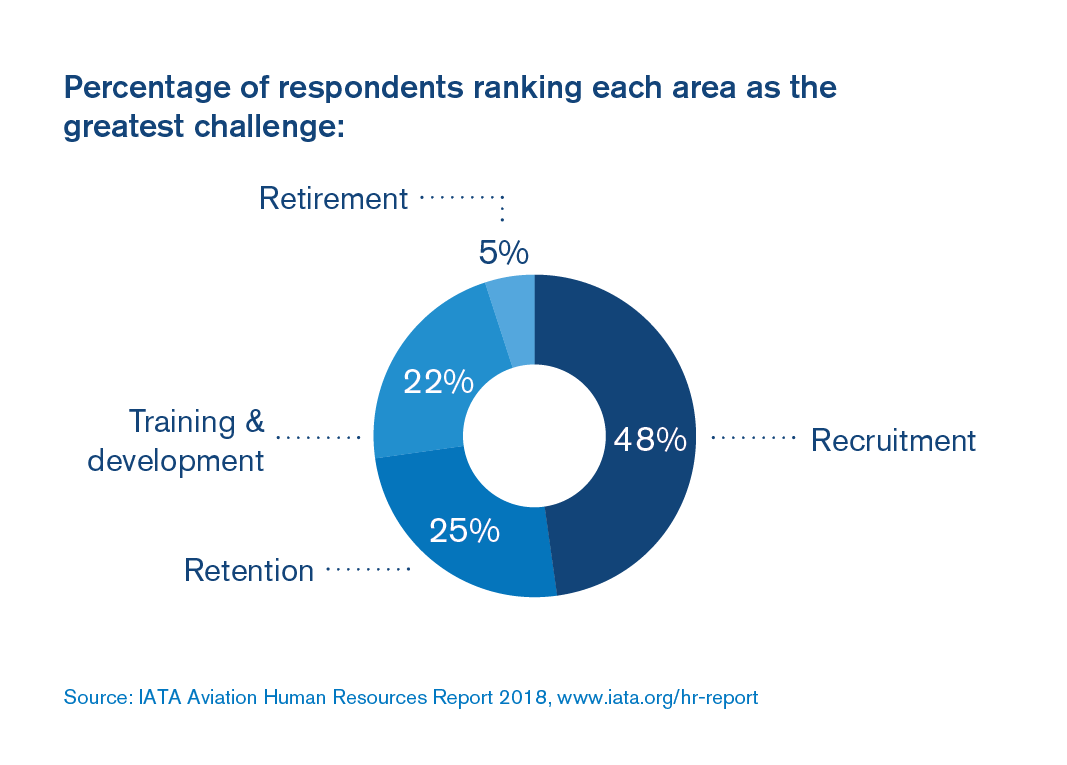
As per a latest report by The International Air Transport Association (IATA), 48 percent respondents identified recruitment as the greatest challenge in aviation sector, followed by retention (25 percent), training and development (22 percent) and retirement (5 percent).
Finding new talent in aviation is the greatest challenge: IATA Report
Reasons like lack of availability of candidates with the right skill levels and qualifications and in some cases, salary demands of new applicants make hiring the greatest challenge for HR professionals in the aviation sector. The findings of the latest IATA Human Resources Report (2018) further reveal that about 25 percent HR professionals see retention as the greatest challenge, while for 22 percent of the respondents training and development is the most critical talent challenge.
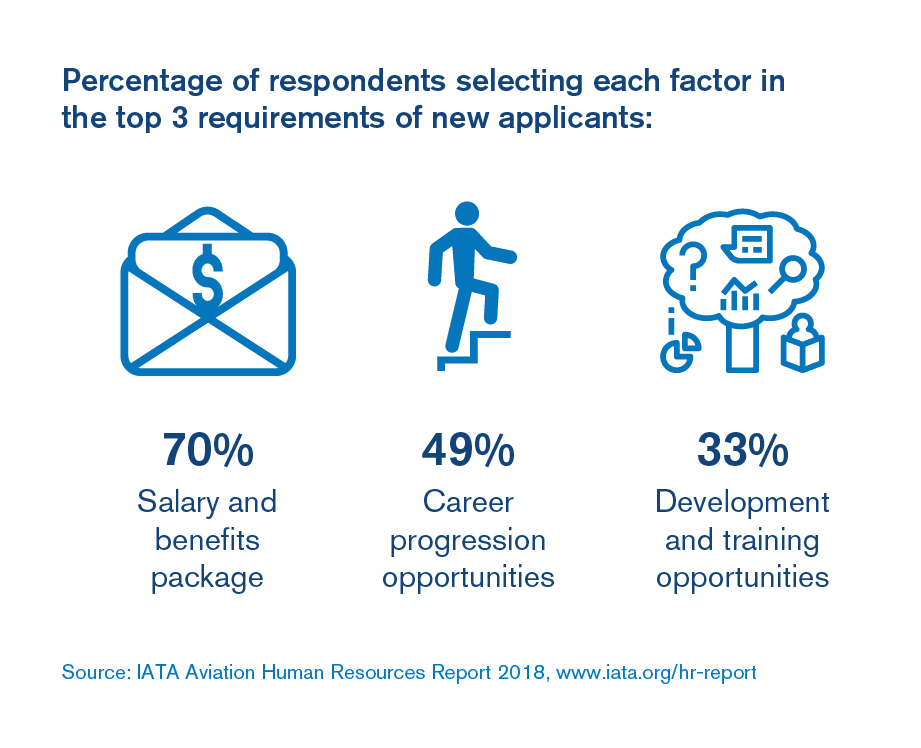
Deep diving further into the aspects which help in attracting and retaining talent the HR professionals identified career progression opportunities (49 percent) and development and training (33 percent) as high priorities in job satisfaction and retention, besides salary packages (70 percent)  which is clearly the top priority for talent. 
The report further highlights the dissatisfaction of HR professionals with current L&D systems in place. Only 28 percent of the respondents reported that current training is effective, with many organizations seeking to complement their in-house training with external partners to improve the effectiveness of the training.
While on one side the IATA report highlighted challenges and areas for improvement, on the other side it also identified the major areas of job growth in the aviation sector. 
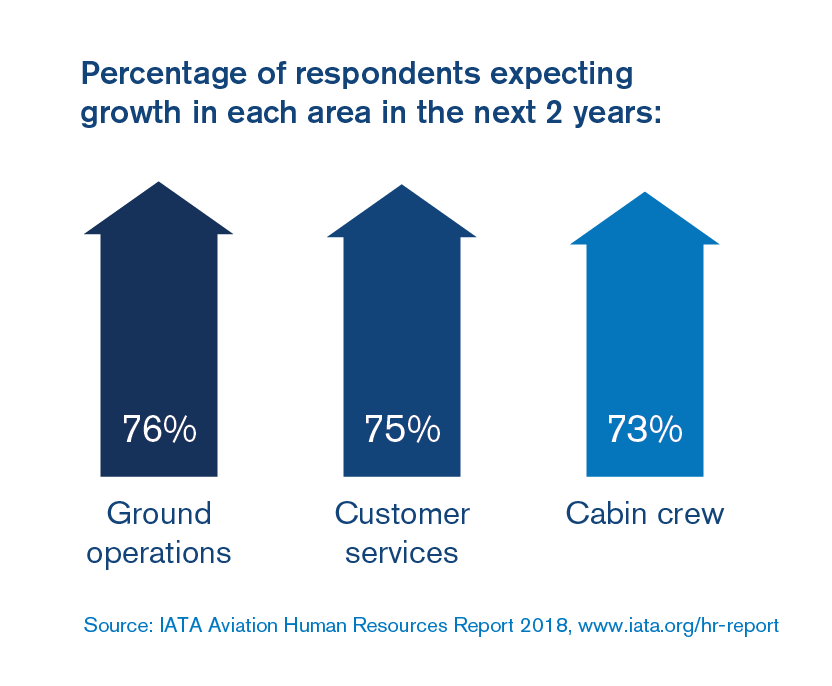
Approximately 75 percent of respondents expect an increase in customer service, ground operations and cabin crew jobs over the next two years. That is higher than the 65 percent of respondents that expect growth in security jobs and 63 percent that expect growth in regulatory positions.
While technology is indeed changing the customer service role, safety and customer service skills remain priorities for hiring managers across the industry. 
Brendan Noonan, Vice President, Talent Development, Qatar Airways Group said “As an airline, we need to find out where the new touchpoints are so that we can bring in customer service to support and complement technology to make the overall customer experience quicker and more enjoyable. There is an expectation from customers and we have to meet that.” 
NDTV Web Developer

47 lakh jobs created in 10 months till June: EPFO Data


47 lakh jobs created in 10 months till June: EPFO Data
According to the payroll data released by the Employees' Provident Fund Organisation (EPFO) for September-May, as many as 44.74 lakh new member were enrolled for its social security schemes to provide benefits, including provident fund, insurance and pension.
47 lakh jobs created in 10 months till June: EPFO Data
The latest data from retirement fund body EPFO's payroll suggests that as many as 47.13 lakh jobs were created during September 2017 to June this year. 
However, the retirement body lowered earlier estimate of new members’ enrolment by 12.38 percent, from 44.74 lakh to 39.20 lakh member for September 2017-May 2018 period. 
 
According to the payroll data released by the Employees' Provident Fund Organisation (EPFO) for September-May, as many as 44.74 lakh new member were enrolled for its social security schemes to provide benefits, including provident fund, insurance and pension. 
As per the latest data uploaded today by the EPFO, the new member’s enrolment in June is the highest so far in the last 10 month at 7,93,308. When it comes to age wise brackets, the maximum number of enrolment of 2,53,466 were recorded in the age bracket of 18 to 21 years followed by 2,05,177 in 22 to 25 age group. 
The data is provisional as updation of employees records is a continuous process and gets updated in subsequent months, the EPFO said in a statement. It also stated that the estimates may include temporary employees, whose contributions may not be continuous for the entire year. 
Earlier this year, the EPFO had started the practice of updating payroll data on its official portal. The body had also lowered its payroll data estimates earlier.
NDTV Web Developer

67% of finance jobseekers in Singapore no longer wait on job offers


67% of finance jobseekers in Singapore no longer wait on job offers
As per new survey data from recruitment firm Robert Half, 88% jobseekers in the financial sector in Singapore are willing to quit within the first month if the job doesn't match their expectations.
67% of finance jobseekers in Singapore no longer wait on job offers
New survey data from recruitment firm Robert Half Singapore reveals that jobseekers within Singapore’s financial sectors are becoming increasingly impatient during the recruitment process.
The survey of 150 CFOs found that the majority, or 67% candidates have become more unwilling to wait to find out if they got the job compared to 12 months ago. Even after accepting a position, 88% are willing to quit within the first month and 91% during their probation period if the job doesn’t match their expectations.
Reasons for leaving during the first month include poor management (59%), followed by a discrepancy between the job in practice and how it was advertised (49%).
 
“As Singapore’s financial employers continue to battle an ongoing skills shortage, top candidates are increasingly gaining leverage during the recruitment process,” Robert Half said.
On reasons why finance candidates have become more unwilling to wait to find out if they got the job, more than half (54%) of CFOs cited a change of attitude in job applicants – which is indicative of the power balance shift towards candidates in a skills-short market. Other reasons include an increase in counteroffers (46%), an increase in jobs available for finance candidates (45%), an increase in the number of interview rounds (41%) and an increase in the total duration of the hiring process (20%).
Robert Half stated that the survey results indicate that Singaporean employers need to streamline their hiring process and make a decision fast once they have found a suitable candidate in order to secure the best talent for the role.
 
Matthieu Imbert-Bouchard, Managing Director of Robert Half Singapore, commented, “ Oftentimes, job seekers receive multiple job offers, which puts them in a much more favorable position when interviewing for a role. Consequently, top candidates are unlikely to wait around if they haven’t received a timely response before accepting an offer elsewhere, highlighting the need for employers to act fast once they have found a match – otherwise they risk losing their preferred candidate to the competition.”
Thus in order to attract and retain the best candidate for the job, businesses need to streamline the recruitment process and provide an engaging experience at every stage, right from initial contact through onboarding and beyond, he added.
NDTV Web Developer

Coca-Cola India announces changes in its leadership team


Coca-Cola India announces changes in its leadership team

The American beverage brand has roped in Chandrasekar Radhakrishnan as Vice-president, Strategy and Insights, for its India operations, and Sundeep Bajoria as Vice-president for its south west Asia operations.
Coca-Cola India announces changes in its leadership team
Coca-Cola India has roped in Chandrasekar Radhakrishnan as Vice-president, Strategy and Insights, for the company’s India operations, and Sundeep Bajoria as Vice-president for its south-west Asia operations. 
Previously, Chandrasekar was heading a worldwide initiative at Nestle India Ltd to optimize marketing efficiencies, besides building the foundation for the company e-commerce competencies. In his career spanning over two decades, Radhakrishnan has also worked with Britannia Industries Ltd, Marico Ltd and Airtel Ltd in a variety of roles across sales, marketing, and business functions.
Chandrasekar will take charge of the company’s strategic initiatives to accelerate the pace of innovation and assess opportunities to offer a broader portfolio of beverages to consumers.
Meanwhile, Sundeep, a Coca-Cola veteran, will work towards making south-west Asia a growth engine for the company. Till recently, Bajoria was Vice-president Strategy and Insights, for Coca-Cola’s India and south-west Asia operations.
 
T Krishnakumar, president, Coca-Cola India and south-west Asia, said in the statement, “We believe there are significant opportunities that lie ahead of us to grow our portfolio. These changes will address developing business needs and pave the way to develop a stronger portfolio for the future.”
The development comes at a time when the local unit of the American beverages company has been trying to make fresh attempts to enter the Indian dairy market with a new set of products, after its unsuccessful attempt with Vio, a ready-to-drink packaged flavored milk brand, launched in 2016
NDTV Web Developer

New global alliance GAME to create 50 Mn jobs in India by 2030


New global alliance GAME to create 50 Mn jobs in India by 2030

GAME has received initial funding commitment of Rs 1 Bn over three years from several Indian and global donors.
New global alliance GAME to create 50 Mn jobs in India by 2030
A group of Indian and international partners yesterday announced the formation of an alliance that aims to catalyze a mass entrepreneurship movement in India with the aim of creating 10 million new entrepreneurs and 50 million new jobs by 2030. 
Former Microsoft India Chairman and founder of GAME Ravi Venkatesan stated that job creation is a challenge and given the size of India, the problem is of higher magnitude. He added that the alliance aims to create a mass entrepreneurship movement in India, with at least half of the 10 Mn entrepreneurs being women.
The coalition, called Global Alliance Mass Entrepreneurship (GAME), has received an initial funding commitment of Rs 100 Cr over three years from several Indian and global donors. 
The announcement was made at a day-long workshop here organized by The Rockefeller Foundation. 
 
Christine Heenan, Vice President for Policy, Partnerships and Communications, The Rockefeller Foundation stated, “Helping more Indian families rise out of poverty remains a challenge we're committed to tackling; creating thousands of new companies and millions of new jobs is key to that. This alliance can make that goal a reality.”
The one day workshop saw participation from about 50 organizations including a Ministry of Skill Development and Entrepreneurship, Ministry of Rural Development, Tata Trusts, state governments of Andhra Pradesh, Odisha, World Bank, Omidyar Network, and Facebook India among others.
Endorsement and support for the alliance has come from many organizations.
 
K.P. Krishnan, Secretary, Ministry of Skill Development and Entrepreneurship, said in a statement, “My ministry fully welcomes and supports this initiative and hopes to benefit by these ideas. One of the foundational ideas in the creation of a Ministry of Skill Development and Entrepreneurship was the notion that skilling should lead to livelihoods generation. The missing link is the ecosystem for creation of mass entrepreneurship. GAME, with potential solutions to this problem, is most timely.”
NDTV Web Developer

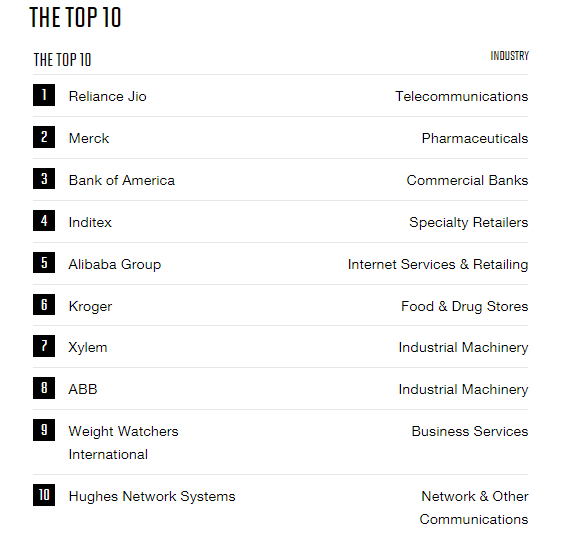
Reliance Jio tops the list of Fortune’s 2018 ‘Change the World’ list


Reliance Jio tops the list of Fortune’s 2018 ‘Change the World’ list
Jio is ranked ahead of companies like Merck, Bank of America, Alibaba.
Reliance Jio tops the list of Fortune’s 2018 ‘Change the World’ list
Reliance Jio has achieved the top spot on the Fortune’s ‘Change the World’ list that ranks companies using the profit motive to help the planet and tackle social problems.
Fortune_Change_The_World_ListSource: Fortune
Fortune prioritizes companies with annual revenues of $1 billion or more. The initial solicitation and assessment of nominees are conducted in partnership with FSG, a nonprofit social-impact consulting firm; the Shared Value Initiative, a global platform for organizations seeking business solutions to social challenges; and Professor Michael E. Porter of Harvard Business School. Fortune writers and editors then evaluate and rank the companies by the following four factors:
  1. Reach, nature, and durability of the company's impact on one or more specific societal problems
  2. Consider the benefit the socially impactful work brings to the company. Profitability and contribution to shareholder value outweigh the benefits to the company's' reputation
  3. How innovative the company's effort is relative to that of others in its industry and whether other companies have followed its example
  4. How integral the initiative is to a company's overall strategy, and how well that strategy is communicated through the ranks and elsewhere
On Reliance Jio occupying the top spot, Fortune says, “The resulting Jio-fiction has been nothing short of revolutionary; with data use surging and Jio’s competitors scrambling to match its offerings, the development has jump-started India’s digital economy. The biggest winners are those in rural areas or of modest means—the farmers, students, and entrepreneurs who finally have in their hands the tool they need to participate in the modern economy.”
Jio attacked the sector with free calls and data forcing rival companies to merge or exit from the market in September 2016 and has amassed 215 million subscribers since then.
NDTV Web Developer

Amazon India’s fintech VP resigns


Amazon India’s fintech VP resigns

Amazon India is set to lose the Senior Executive who mapped its path in financial services and payments.
Amazon India’s fintech VP resigns
Amazon India's fintech Vice-President, Sriraman Jagannathan has resigned. The company has confirmed the development and shared in media, "Sriraman Jagannathan has decided to move on from Amazon for personal/ family reasons." Amazon Pay Head Mahendra Nerurkar will oversee the financial services portfolio currently managed by Jagannathan. Nerurkar took over as Amazon Pay chief executive earlier this year, replacing Jagannathan who was given a more significant role in leading financial services. 
Jagannathan joined Amazon India in January 2016 to lead its payments business, coming from a short stint at IDFC Bank as its Chief Digital and Data Officer. Before that, he had set up and launched Airtel Money as the head of Airtel’s mobile commerce venture. 
Jagannathan writes on his LinkedIn that "My lifetime career goal is to build the world's best virtual bank through merely providing unmatched customer experience and ability to drive business scale. Ability to contribute gigantically to achieving financial inclusion in India by partnering and powering existing banks would be a good compromise."
With over 20 years of experience, he has worked with organizations like Citibank, Bharti Airtel, and IDFC Bank. He is an alumnus of IIM Ahmedabad and completed his engineering from IIT Delhi.
NDTV Web Developer

Times Internet achieves 100% gender pay parity


Times Internet achieves 100% gender pay parity

Times Internet announced that it has achieved the milestone of overall gender pay equality.
Times Internet achieves 100% gender pay parity
Times Internet employing over 5000 employees across eight cities has announced that it has achieved the milestone of overall gender pay equality.
Times Internet had appointed Aon to conduct an independent pay equity audit across the entire organization. The results confirmed that there is no gap between female and male employees concerning pay, rewards, and promotions at the company. 
Gautam Sinha, CEO of Times Internet shared in media that “Pay equity is a huge issue across every industry in every country. We believe that each and everyone deserves respect and equal opportunities for growth. Which is why we worked towards creating a truly meritocratic work culture, wherein every employee is evaluated and rewarded solely by their work and performance, and nothing else.” 
Sharing its journey on achieving the gender pay parity, Times Internet first reviewed its compensation practices to eliminate the existing gender bias and discrepancies. The company adopted an online performance appraisal system, which resulted in an open, fair and transparent process for all employees. The company also initiated diversity training workshops to help employees identify and eliminate conscious and unconscious gender biases. 
Last year, the technology giant, Adobe has introduced a gender pay parity policy in India and US to achieve pay equality between male and female employees across levels. Earlier this year in January, Adobe announced that they had closed the gender pay gap in India.
NDTV Web Developer