


Here's What We Know About Planet Nine
Everything we know about the proposed ninth planet in our solar system
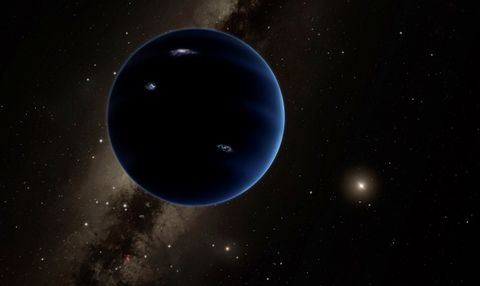
In 2016, a pair of astronomers made an exciting announcement: There might be a hidden planet about ten times the size of Earth lurking somewhere in the most distant part of our solar system, waiting to be discovered. They dubbed this hypothetical world "Planet Nine" and have been looking for it ever since
Three years later, Planet Nine still has yet to be found, but not due to a lack of searching. The two astronomers responsible for the initial hypothesis, Konstantin Batygin and Mike Brown, have been compiling evidencethat they say increases the likelihood Planet Nine really is out there. Now, we're waiting for some enterprising astronomer to spot it.
That is, assuming Planet Nine is even out there to begin with. Astronomers do have a history of making planet predictions that turn out to be less than accurate.
The Wobble of a World
In the early 1800s, there were seven known planets. Uranus had been discovered a few decades prior—in 1781, to be exact—and astronomers spent a great deal of time studying it. One of the stranger things about this newly discovered planet was its orbit, which had some irregularities that couldn't be explained with standard physics. In the 1840s, mathematician Urbain Le Verrier analyzed the planet’s orbit and concluded that the irregularities were caused by another, as-yet-undiscovered planet messing with Uranus gravitationally.
A few weeks after Le Verrier made his announcement, a pair of astronomers in Germany used his calculations to discover the planet Neptune, right where Le Verrier predicted. The incredible thing about this discovery is that Le Verrier was able not only to predict the existence of Neptune but also its exact location using nothing but math and observations of Uranus.
It’s such an incredible feat that astronomers have been trying to replicate it ever since. Shortly after the discovery of Neptune, astronomer Percival Lowell built an entire observatory to hunt for distant, undiscovered planets. Lowell fixated on some small discrepancies in the orbits of Uranus and Neptune and concluded there was another planet out there somewhere. He was wrong, more or less, but spent the rest of his life hunting for his mythical planet.
The Pluto Follies
The Lowell observatory wasn’t a complete waste of money. In 1930, a young researcher at the observatory named Clyde Tombaugh noticed a small moving dot in a telescope plate and announced the discovery of Pluto. Tombaugh's pride became the ninth planet—for most of a century. Then came the 2000s fight over Pluto's planethood, which resulted in the small, cold, distant planet being reclassified as a dwarf planet.
In recent years, a number of small worlds in the outer solar system such as Eris, Sedna, and Makemake have joined Pluto in dwarf planet category. Enough of these small, distant worlds have been discovered that astronomers started noticing a pattern: Many of them have extremely elongated orbits. Sedna, for instance, gets about 7 billion miles from the Sun at its closest, and almost 90 billion miles at its farthest. Sedna isn’t alone; nearly every significant object we’ve found past Pluto has an orbit that looks like a flat oval
This is particularly weird because extremely ovular orbits don’t just happen on their own. This type of orbit can only be formed in a few ways: either all of these worlds were rogue planets captured by our Sun, or their gravity was disrupted by something lurking in our outer solar system. It’s tough to know which possibility is the right one, but there is one clue: All of these distant worlds have their orbits pointing roughly the same way.

It’s highly unlikely that a bunch of random worlds captured by our sun would all be orbiting in the same direction, so that suggests there’s something out there messing with their orbits. That’s the conclusion Brown and Batygin made in their 2016 paper, using the same basic principles Le Verrier used nearly 200 years ago to predict the existence of a new planet hiding somewhere in the black.
No comments:
Post a Comment